How to Start a Nonprofit in Florida: Step-by-Step Guide
If you want to support a cause, serve a community, or create a charitable organization, understanding how to start a nonprofit in Florida is the first step. The process usually involves defining your mission, choosing a name, forming a Florida nonprofit corporation, appointing directors, obtaining an EIN, applying for federal tax-exempt status when appropriate, and handling Florida fundraising and ongoing compliance requirements. While the paperwork is manageable, setting up the organization correctly from the beginning can prevent expensive changes later.
What Does It Mean to Start a Nonprofit?
A nonprofit is an organization created to pursue a mission rather than distribute profits to private owners or shareholders.
However, “nonprofit” and “tax-exempt” do not mean exactly the same thing.
You can create a nonprofit corporation under Florida law without automatically receiving federal tax-exempt status. If your organization qualifies and wants federal recognition under Section 501(c)(3), you generally need to apply separately to the IRS.
That distinction matters because incorporating with Florida establishes the legal entity, while IRS approval determines whether the organization receives the specific federal tax treatment associated with its approved exemption.
If you are still deciding whether this structure fits your idea, a broader How to Start a Nonprofit guide can help you compare the overall nonprofit formation process before focusing on Florida-specific requirements.
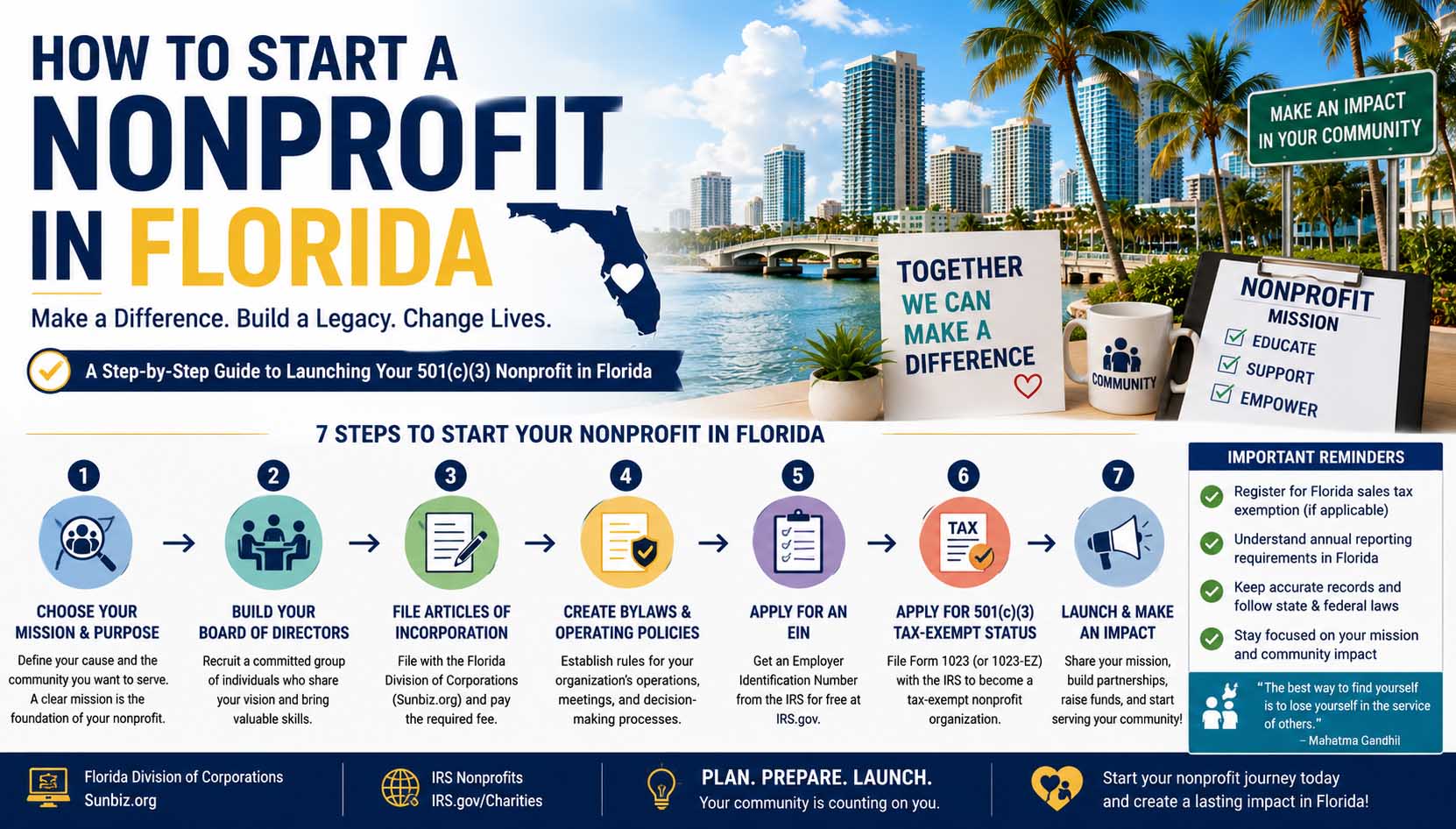
How to Start a Nonprofit in Florida Step by Step
The exact path depends on the organization’s purpose and tax classification, but most charitable nonprofits follow a similar sequence.
1. Define a Clear Mission
Before filing anything, decide exactly what the organization will do.
A useful mission answers three questions:
- Who does the organization serve?
- What problem does it address?
- How will it create an impact?
For example, “helping people” is too broad. A stronger mission might focus on providing after-school literacy support to elementary students in a particular Florida community.
Clear wording becomes useful when preparing incorporation documents, grant applications, fundraising materials, and the IRS exemption application.
If this part feels difficult, studying How to Write a Mission Statement can help you turn a general idea into a focused organizational purpose.
2. Choose a Florida Nonprofit Name
Next, choose a name that works for your organization and can be distinguished from other entities registered with the Florida Division of Corporations.
Before committing to branding, domain names, signs, or printed materials, search Florida’s Sunbiz records to see whether a similar corporation already exists.
A good nonprofit name should also make sense to donors and beneficiaries. Ideally, someone should be able to understand at least part of the organization’s mission from the name.
However, avoid choosing something so narrow that it becomes limiting if the nonprofit later expands its programs.
3. Build Your Initial Board
A nonprofit corporation operates through a board of directors rather than an individual owner.
The board provides oversight, approves major decisions, helps protect the mission, and monitors how organizational resources are used.
Therefore, choose people who bring useful skills rather than simply asking friends to fill seats. Depending on the organization’s work, useful board experience might include finance, legal issues, fundraising, marketing, community engagement, education, or program management.
You should also think about independence. For organizations seeking 501(c)(3) status, strong governance practices can reduce conflicts of interest and improve credibility with donors and grant makers.
File Your Florida Nonprofit Articles of Incorporation
One of the central steps in how to start a nonprofit organization in Florida is filing Articles of Incorporation with the Florida Department of State, Division of Corporations.
Florida’s official Division of Corporations nonprofit filing information provides the state process and filing information for forming a nonprofit corporation.
As of August 2026, Florida lists a $35 filing fee plus a $35 registered-agent designation fee for a new nonprofit corporation. Optional certified copies and certificates of status cost extra.
Your filing generally includes information such as:
- Corporate name
- Principal office address
- Mailing address
- Specific purpose
- Registered agent
- Incorporator information
- Directors, when listed
- Other provisions you choose or need to include
If you plan to apply for 501(c)(3) status, the articles should contain language that meets IRS organizational requirements, including an appropriate charitable purpose and provisions dealing with distribution of assets upon dissolution.
Simply filing generic articles and trying to fix them later can create extra work. Therefore, founders planning to seek federal exemption should prepare the articles with that goal in mind from the start.
Florida also warns that information submitted in these filings becomes part of the public record, so avoid putting unnecessary private information into public-facing fields.
Appoint a Registered Agent
Every Florida corporation needs a registered agent.
The registered agent receives official legal and government documents for the corporation and needs a Florida street address that satisfies state requirements.
The agent may be an individual or eligible business entity.
Although founders sometimes serve as their own registered agents, consider whether you want your address to appear in public records and whether someone will reliably be available to receive important documents.
Create Bylaws and Governance Policies
Bylaws explain how your nonprofit will operate internally.
Florida does not require you to file bylaws with the Division of Corporations, but well-written bylaws are still a core organizational document.
Typical bylaws cover:
- Board structure
- Director terms
- Officer responsibilities
- Voting procedures
- Meeting rules
- Committees
- Removal or replacement of directors
- Recordkeeping
- Conflict handling
You should also consider adopting a conflict-of-interest policy, particularly if you intend to apply for 501(c)(3) recognition.
During the organizational meeting, the board can approve the bylaws, elect officers, authorize opening a bank account, approve initial policies, and document other startup decisions.
Get an EIN From the IRS
A nonprofit generally needs an Employer Identification Number, or EIN, even if it does not immediately hire employees.
The EIN works as the organization’s federal tax identification number.
For example, you may need it to open a bank account, submit federal tax forms, apply for exemption, hire employees, and work with financial institutions.
The IRS issues EINs separately from Florida’s state incorporation process. Therefore, forming the corporation through Sunbiz does not automatically give you a federal EIN.
Apply for 501(c)(3) Tax-Exempt Status
Many charitable nonprofits seek recognition under Section 501(c)(3) of the Internal Revenue Code.
Qualifying organizations may include those formed for charitable, educational, religious, scientific, literary, or certain other exempt purposes.
Applicants normally use Form 1023 or, when eligible, the streamlined Form 1023-EZ.
As of August 2026, the IRS lists a $600 user fee for Form 1023 and $275 for Form 1023-EZ. Form 1023-EZ eligibility must be determined using the IRS eligibility worksheet.
However, do not choose Form 1023-EZ simply because it costs less. Some organizations are not eligible for it, while others may benefit from preparing the full application because of their structure or activities.
Your IRS application may ask for information about:
- Organizational purpose
- Programs and activities
- Compensation
- Fundraising
- Financial projections
- Board relationships
- Conflict-of-interest issues
For complex organizations, professional legal or tax guidance may be worthwhile.
Register Before Soliciting Donations in Florida
Forming the corporation and obtaining 501(c)(3) status does not automatically satisfy every Florida fundraising requirement.
Florida’s Solicitation of Contributions Act generally requires organizations that solicit donations in or from Florida to register with the Florida Department of Agriculture and Consumer Services and renew that registration annually, unless an exemption or alternative requirement applies.
This step matters for organizations that plan to request donations through websites, events, mail, social media, or other fundraising channels.
Florida also requires certain disclosures on solicitations for organizations covered by the law. Therefore, check the current FDACS rules before launching a major fundraising campaign.
Do Florida Nonprofits Need Business Licenses?
A nonprofit may still need local or activity-specific permits.
The answer depends on what the organization actually does.
For instance, operating a childcare program, selling goods, serving food, running certain events, or providing regulated services may trigger local, state, or professional requirements.
That is why understanding types of business licenses is useful even for nonprofit founders. Nonprofit status does not automatically exempt an organization from every operational license or permit.
Therefore, check city, county, state, and industry-specific rules before beginning regulated activities.
How Much Does It Cost to Start a Nonprofit in Florida?
Startup costs vary significantly.
A basic cost framework may look like this:
| Expense | Typical Requirement |
|---|---|
| Florida nonprofit filing | $35 filing + $35 registered agent designation |
| Certified copy | Optional |
| Certificate of status | Optional |
| EIN | Generally no IRS application fee |
| Form 1023-EZ | $275 IRS user fee |
| Form 1023 | $600 IRS user fee |
| Legal/accounting help | Varies |
| Charitable registration | Depends on applicable requirements |
| Website/branding | Optional and variable |
| Local permits | Depends on activity and location |
Florida currently lists the nonprofit annual report fee at $61.25.
When budgeting, consider ongoing types of expenses as well, including insurance, accounting, fundraising software, website hosting, program supplies, payroll, rent, professional services, and compliance costs.
A nonprofit needs financial sustainability just as much as a commercial business does.
How to Start a Nonprofit in Florida With No Money
People often search for how to start a nonprofit in Florida with no money, but creating a formal organization usually involves some unavoidable costs.
Florida’s required state incorporation charges and IRS exemption application fees mean the complete process is not literally free.
Still, founders can reduce startup expenses.
For example, volunteers can handle initial planning, website development, outreach, and administrative work. Some lawyers, accountants, university clinics, or nonprofit-support organizations may offer free or low-cost assistance.
You could also consider fiscal sponsorship. Under the right arrangement, an existing qualifying nonprofit may support a new charitable project while the project develops its own structure.
However, this option requires a legitimate agreement and proper oversight, so it should not be treated as a shortcut around nonprofit rules.
Can You Start a Nonprofit in Florida for Free?
If someone searches how to start a nonprofit in Florida for free, the realistic answer is that you can plan the organization for little or no money, but government filing and exemption costs generally remain.
You can reduce unnecessary expenses by:
- Drafting your business and program plan yourself
- Recruiting volunteer board members
- Using free productivity tools
- Avoiding expensive branding at launch
- Applying directly through official government websites
- Seeking pro bono professional help
However, never save money by skipping required compliance.
Correcting a badly structured nonprofit later can cost much more than setting it up properly at the beginning.
Nonprofit vs Foundation
Some founders use “nonprofit” and “foundation” interchangeably, yet the terms can involve different structures and funding models.
A public charity may receive support from many donors, grants, programs, or fundraising campaigns. By contrast, a private foundation is often supported by a smaller source of funding and operates under additional tax rules.
If your plan involves establishing a grant-making entity or a family-funded charitable vehicle, a guide on How to Start a Foundation can help clarify whether that structure better matches your goals.
Professional tax advice is especially useful when substantial assets or private-foundation rules are involved.
Keep Your Florida Nonprofit Compliant
Formation is only the beginning.
Florida states that nonprofit annual reports are due during the filing period from January 1 through May 1 of the calendar year following the corporation’s filing or effective date.
A tax-exempt organization may also have ongoing IRS filing requirements, such as the appropriate version of Form 990.
Meanwhile, organizations soliciting contributions in Florida may need annual FDACS renewal.
Good recordkeeping should include board minutes, donation records, financial statements, contracts, receipts, payroll documents, tax filings, and major policies.
Common Mistakes New Nonprofits Make
The first mistake is filing before defining the mission clearly. Vague goals make everything from IRS applications to fundraising harder.
Another problem is treating the nonprofit like a founder-owned business. A charitable nonprofit exists for its exempt purpose rather than to generate personal financial benefit for its founder.
Weak boards also create problems. Directors should actively provide oversight instead of existing only on paperwork.
Likewise, some founders assume receiving an EIN means they have 501(c)(3) status. It does not.
Finally, do not start fundraising without checking Florida’s solicitation rules. Compliance should be established before large campaigns begin.
FAQs About Starting a Florida Nonprofit
How Long Does It Take to Start a Nonprofit in Florida?
Timing varies according to state processing, preparation time, IRS exemption processing, and whether additional registrations are required. Forming the Florida corporation is only one stage of the process.
Do I Need an Attorney?
Florida does not generally require an attorney simply to file a nonprofit corporation. Still, legal advice can be valuable for complicated governance, tax-exemption, compensation, contracts, or regulatory issues.
Can One Person Start a Nonprofit?
One person can begin planning an organization, but nonprofit governance usually involves a board structure. If you plan to seek 501(c)(3) status, building a credible and appropriately independent board is a good practice.
Can I Pay Myself From a Nonprofit?
A nonprofit can compensate employees, including founders, for legitimate work. However, compensation must be reasonable and consistent with applicable nonprofit and tax rules. The organization cannot simply distribute profits to founders like owners of a for-profit company.
Is a Nonprofit the Same as a Nonprofit Business?
People sometimes search how to start a nonprofit business in Florida, but legally the more accurate concept is usually a nonprofit corporation or other qualifying nonprofit entity. It can operate professionally and earn revenue, but its assets and earnings must support its nonprofit purpose rather than private ownership.
Practical Next Steps
Knowing how to start a nonprofit in Florida becomes much easier when you treat formation as a sequence rather than one large task.
Start with a clear mission and capable board. Next, choose your name, prepare compliant Articles of Incorporation, appoint a registered agent, create bylaws, and obtain an EIN. Then, evaluate whether 501(c)(3) recognition fits your organization and complete Florida fundraising registration when required.
After launch, maintain good records and keep up with annual state, federal, and fundraising obligations. A nonprofit can create meaningful community impact, but strong governance and compliance give that mission a much better chance of lasting.